


The moment you start wondering
is the time to begin
Even if you feel that everything is still fine.
We offer early assessment with AI-assisted EEG analysis
and preventive support through personalised programmes.


A specialist clinic for dementia prevention
Keep your work, your family and your life in mind.
Care for your future, here in Ginza.
As we will switch electronic medical record systems in December 2026, please contact us by telephone or email for appointments and enquiries from December onward, rather than through the Digisuma app. Digisuma will remain available as usual until November 30.


Ginza Recharge Clinic is a private clinicwith a mission to make dementia risk visibleand take action to slow its progression.
We support your health in an age of longer lives, focusing on stimulation therapies and care for the brain and autonomic nervous system using next-generation devices and treatments.
Experience care that uses advanced technology to support your mind and body and restore vitality. Start caring for your future at Ginza Recharge Clinic.
Start by noticing
small changes in everyday life.


A diagnosis of MCI (mild cognitive impairment)
does not mean that everyone
will develop dementia.
The key is to combine these two approaches.
Even if you feel that everything is still fine.
We offer early assessment with AI-assisted EEG analysis
and preventive support through personalised programmes.

From brain and autonomic nervous system assessments to treatment and care,
we offer options suited to your condition.


Psychiatrist Dr. Taksa Ko draws on extensive clinical data to assess the condition of the brain, mind and body.

A 20-minute EEG recording quantifies dementia risk and autonomic balance, helping identify areas of concern at a glance.

We combine advanced devices such as hydrogen inhalation, PBM and NeuroMyst Pro+ to provide personalised care based on your assessment results.
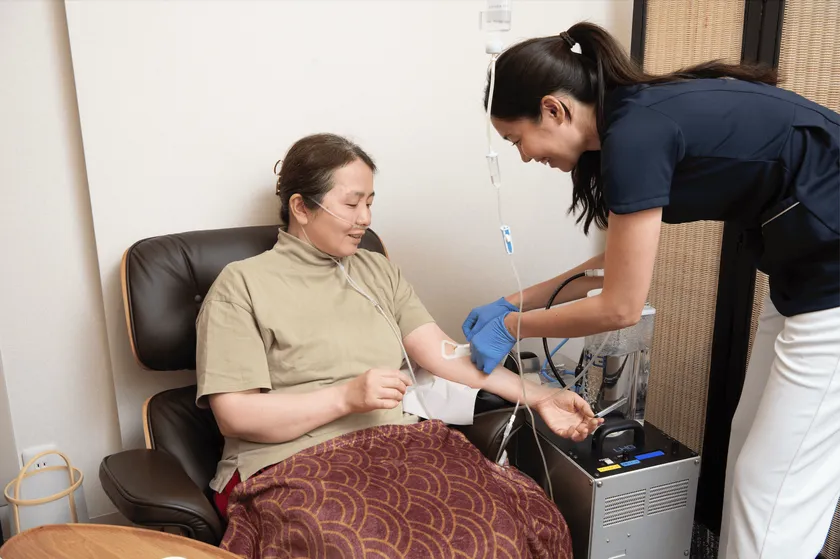
Short, appointment-only visits near the station make it easy to stop by during lunch or after work, with no special preparation and privacy respected.


Natural wood interiors and soft indirect lighting.
A relaxing space where you can feel at ease.

A clinic in Ginza where everyone is welcome.
Perhaps you want to regain your energy or feel the excitement of trying something new, whatever your age. I want this clinic to be a place where you can share those hopes. Wherever you’re from and whatever your background, I’ll take the time to listen. Together, we can find healthy habits that fit your life.
Welcome to Ginza Recharge Clinic. My name is Taksa Ko. As director, I am delighted to introduce our clinic and to help you improve your health.
For more than 20 years, I have worked in mental health care within the health insurance system, learning a great deal through clinical practice. Along the way, I began to imagine a different kind of care I wanted to provide. That vision gradually took shape, and our clinic celebrated its grand opening in December 2023.
What is Ginza Recharge Clinic? My hope is to create an international clinic that helps anyone, regardless of nationality or ethnicity, build new health habits and rediscover energy, vitality and a youthful spirit. Nothing brings our team greater joy than hearing, ‘I am glad I came here. I feel better.’
The first pillar of our approach is care for the ageing brain. We actively use advanced EEG devices and other technologies to help maintain brain health and unlock the extraordinary potential of the human brain.
Our second pillar is a programme to address fatigue, which is said to affect more than 40% of Japanese people chronically. Fatigue can be a gateway to lifestyle-related conditions and mental imbalance. Our programmes aim to address it appropriately and support recovery of both mind and body.
Our staff can assist you in English, and some also speak Chinese and other languages. As an international clinic, we welcome people from around the world, regardless of nationality or ethnicity.
Join us in exploring the possibilities that life still holds, renewed health and a future with more vitality. Recharge for a brighter, more energetic tomorrow!
We look forward to welcoming you.
Director, Ginza Recharge Clinic 
By appointment only
Please feel free to discuss concerns about yourself or your family. A specialist will listen carefully and suggest an appropriate direction for your care.
Telephone hours: 10:00–18:00 / Closed Sundays and public holidays
Ginza Silk Building, 8F
4-6-17 Ginza, Chuo-ku
Tokyo 104-0061, Japan
From Exit A8, walk towards Matsuya Ginza with Mitsukoshi on your right.
Take the entrance stairs to the left of Taya up to the 2nd floor,
then take the lift to the 8th floor.
Schematic map for orientation only. Distances and scale are not exact.
1
Walk along Chuo-dori with Ginza Mitsukoshi on your right. Look for Taya, the necktie shop.
2
First, take the stairs at the building entrance up to the 2nd floor.
3
The lift starts on the 2nd floor. Our clinic is on the 8th floor of the Ginza Silk Building.
Please call us if you have trouble finding the entrance.
03-5579-5900If you already know which test or treatment you would like, please see the fees on the individual treatment pages. If you prefer to decide after seeing the doctor, we cannot give a definite total at this stage. During your visit, we will discuss your options and, as far as possible, agree on care that fits your budget.
With conventional treatment covered by insurance, medication could slow progression, but recovery was difficult. With advances in medicine and newer brain stimulation devices, improvement has been observed, particularly at earlier stages. Ideally, assessment begins at the MCI stage (mild cognitive impairment, a stage before dementia). However, we encourage people with mild to moderate dementia to consult us too. If you wish, we can first assess your current level of dementia risk.
Dementia is said to develop silently for 20–30 years before symptoms appear. Ideally, assessment begins in your 40s, but if you are 50 or older, we encourage you to visit as early as possible.
Ideally, assessment every six months to one year is recommended, although the timing can be adjusted to your circumstances. Comparing results helps you see changes in brain function and condition, which can provide encouragement as you continue treatment.
Vitamin D is closely linked to brain function as well as bone density. It helps maintain memory and concentration through neuroprotection associated with reduced neuroinflammation, regulation of neurotransmitters such as serotonin and dopamine, and support for synapses, the connections between nerve cells. Animal studies have also linked vitamin D deficiency with accelerated ageing and a shorter lifespan. Yet more than 90% of people today are said to have insufficient levels. We include vitamin D in our standard blood test panel as a nutrient that helps protect the brain.
Recent studies have reported a range of potential health effects of hydrogen inhalation. This refers to inhaling hydrogen through the nose, rather than drinking the ‘hydrogen water’ that was once popular. Hydrogen is considered effective at removing reactive oxygen species in the brain and body, with potential benefits including recovery from fatigue, improved cognitive function (memory and concentration), relaxation, and improvement in allergies, cold extremities associated with reduced circulation, and migraine.
Fermented foods increase beneficial gut bacteria and short-chain fatty acids, nutrients that support both the gut and brain. Exercise increases brain-derived neurotrophic factor (BDNF) and promotes intestinal peristalsis, the movements that push digested food through the bowel. The gut and brain are also closely connected through the vagus nerve, a long nerve of the autonomic nervous system, in what is called the gut–brain axis. Supporting gut health and exercising therefore also help support the condition of the brain.
Yes. Recent research has shown that lifestyle has a greater influence on dementia risk than previously understood, including compared with genetic factors. Lifestyle-related conditions such as diabetes, high blood pressure and dyslipidaemia are among these factors, so we recommend checking them early.
It depends on the injury. Extensive brain damage, loss of consciousness and repeated head impacts, for example from sport, are associated with a particularly increased risk.
If this applies to you, we encourage you to seek assessment.
We can assess abilities needed for driving, including attention, memory and response speed, through detailed cognitive testing and EEG assessment. You might encourage him to come by explaining that it is a place to check whether he is still able to drive safely, rather than presenting it as a hospital visit.


